You may wonder what is a amplification system for classrooms. This system uses a wireless microphone, amplifier, and speakers to make your teacher’s voice clear and easy to hear. When your teacher speaks, the sound travels through the system and reaches every corner of the room. This helps students focus and understand lessons better. A classroom with good sound can change speech intelligibility from poor to good, especially when reverberation drops from 1.2 to 0.6 seconds. The system also boosts the teacher’s voice above background noise, reaching an ideal signal-to-noise ratio of +15 dB.
Classroom Condition
Reverberation Time (seconds)
Speech Intelligibility
Before Acoustic Treatment
1.2
Poor
After Acoustic Treatment
0.6
Good
Key Takeaways
A classroom amplification system makes the teacher’s voice louder and clearer so all students can hear well, even in noisy or large rooms.
The system includes a wireless microphone, amplifier, and speakers that work together to spread sound evenly throughout the classroom.
Using amplification helps students focus better, understand lessons more easily, and supports those with hearing loss or language challenges.
Teachers benefit by saving their voices and reducing strain, which helps them teach more comfortably and effectively.
Proper setup and integration with classroom technology ensure the system works well and keeps everyone engaged and included.
What is a Classroom Amplification System
Main Purpose
When you ask what is a classroom amplification system, you want to know how it helps you learn. The main purpose of this system is to make your teacher’s voice louder and clearer for everyone in the room. You hear every word, even if you sit at the back or near a noisy hallway. This system supports students with hearing loss, but it also benefits everyone by reducing the effects of background noise and distance from the teacher.
You may notice that teachers often speak for hours each day. Without help, their voices can get tired or strained. Classroom amplification systems help teachers project their voices without shouting. Research shows that teachers who use these systems experience less vocal fatigue, especially in large or busy classrooms. You get a more consistent and energetic lesson because your teacher does not have to work as hard to be heard.
Studies show that these systems do more than just make things louder. They improve speech perception, attention, and learning outcomes for all students. For example, students with hearing aids or cochlear implants benefit from personal FM systems, which send the teacher’s voice directly to their devices. Sound-field systems spread the teacher’s voice evenly, so everyone hears the lesson clearly. When you learn in a classroom with good sound, you understand instructions better and stay focused longer.
Did you know? In classrooms using amplification systems, teachers report improved attentiveness and comprehension among students. Administrators also notice better classroom management and instruction.
Core Features
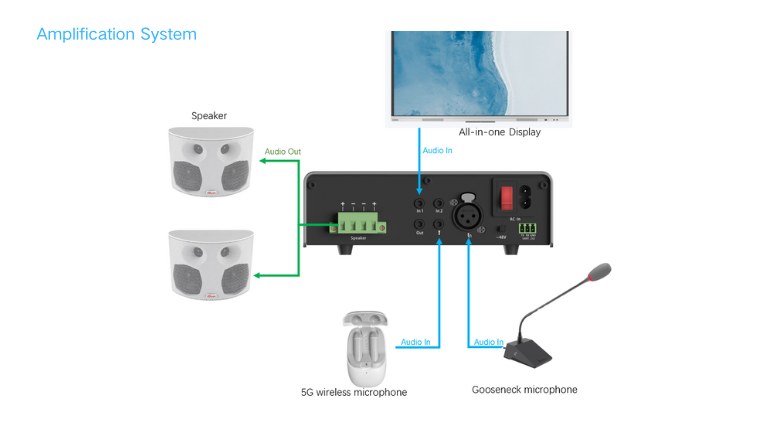
You might wonder what makes up a classroom amplification system. When you look at what is a classroom amplification system, you see several important parts working together:
Wireless Microphone: Your teacher wears a small microphone, usually clipped to their shirt or worn around the neck. This device picks up their voice clearly.
Wireless Transmitter and Receiver: The microphone sends the sound wirelessly to a receiver in the classroom. This can use FM radio waves, infrared light, or induction loops.
Classroom voice amplifier: The receiver connects to an amplifier, which boosts the sound so it can fill the room.
Speakers: Loudspeakers placed around the classroom distribute the teacher’s voice evenly. You hear the lesson no matter where you sit.
Student Microphones (optional): Some systems include microphones for students. This lets everyone participate and be heard by the whole class.
You find different types of systems, such as FM, Loop Induction, and Infrared. Each type works best in certain situations. For example, FM systems are great for students with hearing aids, while sound-field systems help everyone in the room.
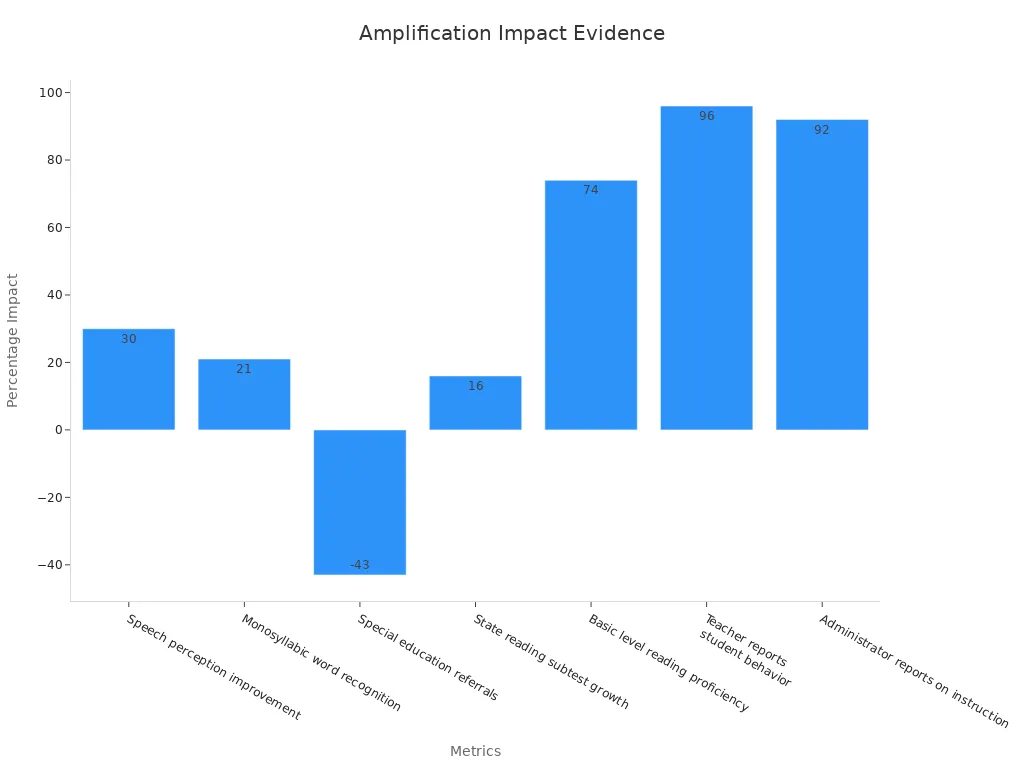
Here is a table that shows how classroom sound systems can improve learning outcomes:
English language learners showed up to 30% better speech perception scores
Monosyllabic word recognition
21 percentage point increase
Amplified classrooms had 79% correct recognition vs. lower in unamplified
Special education referrals
43% decrease over 5 years
Fewer students referred to special education in classrooms using amplification
State reading subtest growth
16% average growth
English language learners in Utah showed 16% growth on state reading tests
Phonological awareness test scores
78% vs. 57% above mean
Students in amplified classrooms scored higher on awareness tests
Basic level reading proficiency
74% scored basic or above
First graders in Utah improved by over 30 percentage points
Teacher reports of student behavior
96% positive response
Teachers reported improved attentiveness, listening, and comprehension
Administrator reports on instruction
92% positive response
School administrators noted enhanced class instruction and management
When you think about what is a classroom amplification system, remember that it is more than just a microphone and speakers. It is a complete solution that helps you hear better, learn more, and feel included in every lesson.
You see the wireless microphone as the heart of the sound amplification system. Your teacher wears this small device, often clipped to a shirt or worn around the neck. The microphone picks up the teacher’s voice and sends it wirelessly to the amplifier. This process keeps the teacher’s voice clear, even when background noise rises. Research shows that wireless microphones improve speech intelligibility, especially in noisy classrooms or for students with language disorders. You benefit from this technology because it helps you hear every word, no matter where you sit.
Performance Metric
Description
Measurement Method / Details
Speech Intelligibility
Measures how clearly you hear your teacher
Standardized speech tests in real classroom conditions
Noise Levels Tested
Shows how well the microphone works in different noise levels
Ensures your teacher’s voice stands out above background noise
Adjusted for a 10 dB FM advantage
Subjective Ratings Correlation
Confirms that what you hear matches what the tests show
User ratings align with measured results
Tip: A good wireless microphone system helps your teacher’s voice stay clear, even when the classroom gets loud.
Amplifier
The amplifier boosts the sound from the microphone. You hear the teacher’s voice at a comfortable volume, not too loud or too soft. The classroom amplifier makes sure the sound reaches every corner of the room. Studies confirm that amplification systems reduce the negative effects of background noise and reverberation. You get better speech clarity and attention, which helps you learn more effectively. Standards recommend a signal-to-noise ratio of +15 dB or higher, so the amplifier plays a key role in meeting this goal.
Research identifies six key design enablers for classroom comfort: material, volume, layout, amplification system, noise, and occupancy.
Critical acoustic parameters include reverberation time, background noise, and speech clarity. The amplifier helps control these factors.
Speakers
Speakers distribute the amplified sound evenly throughout the classroom. You hear your teacher clearly, whether you sit in the front row or the back. Good speaker placement reduces dead spots and echoes. The system uses multiple speakers to cover the whole room. This setup supports students with hearing loss and helps everyone stay focused. Objective measures like the Speech Transmission Index (STI) show that well-designed speaker systems improve speech clarity and learning outcomes.
Note: When you use a classroom amplification system with quality speakers, you experience better attention and understanding during lessons.
When you use a classroom amplification system, the process starts with your teacher’s voice. Here is how the sound travels through the system:
The microphone captures your teacher’s voice and changes it into electrical signals.
These signals move to an amplifier, which makes them stronger.
The amplifier sends the signals to speakers placed around your classroom.
The speakers turn the signals back into sound waves, making your teacher’s voice louder and clearer for everyone.
Some systems use Digital Signal Processing (DSP) to remove echoes and reduce noise, so you hear only the important sounds.
Advanced microphones, like those in the IQSpeakerphone S230, can pick up voices from all directions, making sure nothing gets missed.
Networked AV control systems, such as Q-NEX NMP, help send sound quickly and can make it up to ten times louder before it reaches your ears.
Tip: When your classroom uses this system, you hear your teacher clearly, even if you sit far away or there is background noise.
Wireless Technology
Classroom amplification devices use different wireless methods to send sound from the microphone to the speakers. Each method has its own strengths and limits. Here is a quick look at the main types:
Sound Transmission Method
Operation Principle
Advantages in Classroom Settings
Limitations
FM Systems
Radio waves
Works indoors and outdoors; helps students with hearing loss; can go through walls
Needs separate frequencies; possible interference
Infrared Systems
Invisible light beams
Secure; no spillover to other rooms
Needs direct line of sight; sunlight can cause problems
Sound Field Amplification
Speakers in classroom
Makes speech 10-12 dB louder than noise; helps many students
May not work well in rooms with lots of echo
Loop Systems
Electromagnetic fields
Direct to hearing aids; easy to install
Only works with special hearing aids or receivers
You find that FM systems use radio waves to send sound up to 300 feet, even through walls. Infrared systems use light beams, so they need a clear path between the microphone and receiver. Loop systems send sound straight to hearing aids, cutting out background noise. Sound field systems use speakers to make sure everyone hears the lesson.
Note: These wireless technologies help you hear better, stay focused, and learn more, no matter where you sit in the classroom.
Integration
Classroom Setup
You want your classroom amplification system to work well from the start. Careful setup makes a big difference. You should think about where to place the speakers and microphones. Place speakers around the room so every student hears the teacher clearly. Avoid putting speakers too close to walls or corners, which can cause echoes. Soft materials like carpets and sound-absorbing ceilings help reduce noise and make speech clearer. Moveable furniture can change how sound travels, so check the setup if you rearrange desks or tables.
Many schools use expert installers to make sure the system fits the classroom’s needs. Professionals design custom solutions that work with flexible furniture and group activities. They follow standards like LEED, CHPS, and ANSI S12.60 to control noise and improve speech clarity. You may see systems like the DigiMaster 5000, which uses a special speaker array to spread sound evenly. Before using the system, teachers often get training to use the microphones and controls correctly.
Teacher training ensures you get the most benefit from the system.
Tip: Always test the system after moving furniture or making changes to the room.
Compatibility
Your classroom amplification system should work smoothly with other technology. Modern systems connect easily to interactive displays, wireless collaboration tools, and centralized control panels. This makes it simple for you and your teacher to manage all devices from one place. Scalable designs let you add new technology as your classroom grows.
Centralized control systems make it easy to manage microphones, speakers, and displays.
Custom solutions adapt to new educational tools, keeping your classroom future-ready.
Integrated systems support students with hearing aids or personal FM devices.
Maintenance is simple. You should check batteries in wireless microphones and keep speakers dust-free. If you hear feedback or the sound is unclear, check the microphone placement and connections. Most problems have quick fixes, so your learning stays on track.
Note: A well-integrated system helps everyone in the classroom stay engaged and included, no matter what technology you use.
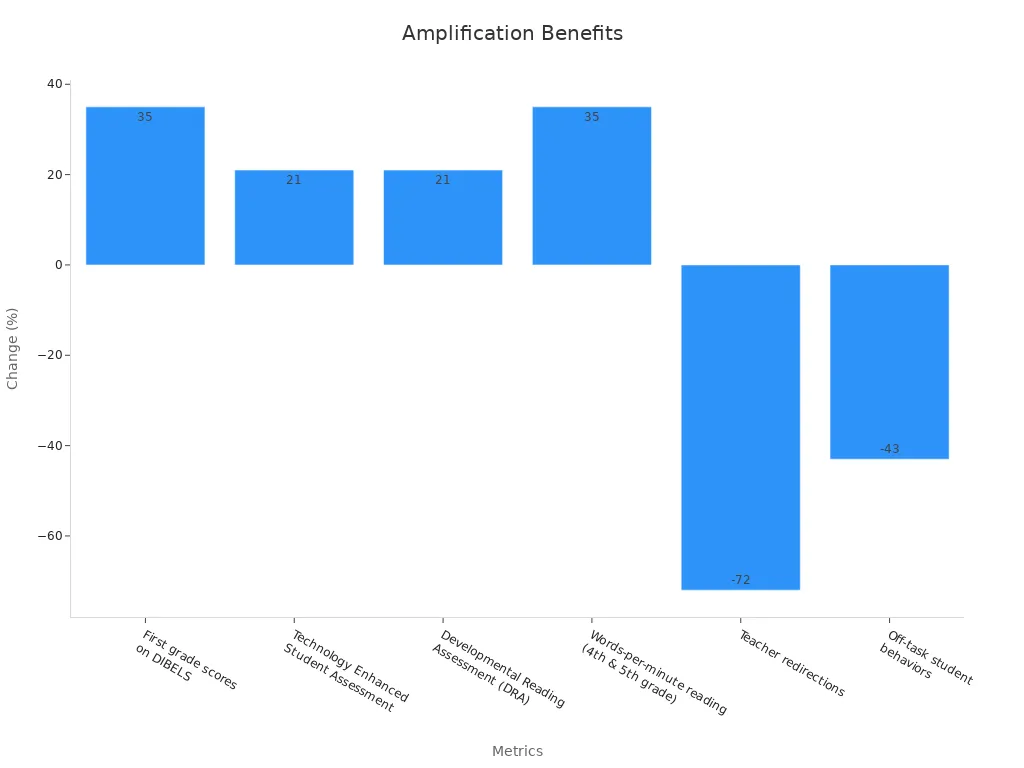
You now know what is a classroom amplification system and how it can change your learning. These systems help you hear your teacher clearly and stay focused. Teachers save their voices and spend less time redirecting students. The table below shows how classrooms improved with these systems:
Metric
Improvement/Change
First grade scores on DIBELS
+35%
Technology Enhanced Student Assessment
+21%
Developmental Reading Assessment (DRA)
+21%
Words-per-minute reading (4th & 5th grade)
+35%
Teacher redirections
-72%
Off-task student behaviors
-43%
If you want a classroom where everyone can listen and learn, consider using this technology. You can ask your school about more resources or talk to your teacher about trying a system.
FAQ
What if your classroom already feels quiet?
You still benefit from an amplification system. Even in quiet rooms, your teacher’s voice can fade at the back. The system helps everyone hear clearly, so you do not miss important instructions or details.
Can you use a classroom amplification system with hearing aids?
Yes, you can. Many systems connect directly to hearing aids or cochlear implants. This setup sends your teacher’s voice straight to your device, making it much easier to follow lessons.
Does the system pick up student voices?
Some systems include student microphones. You can use these to share answers or ask questions. Everyone in the room hears you clearly. This feature helps group discussions and class participation.
Is it hard to set up or maintain the system?
You do not need special skills to use most systems. Teachers get simple controls. Maintenance usually means checking batteries and keeping microphones and speakers clean. If you have problems, quick fixes often solve them.
Will the system work with other classroom technology?
Most modern systems work with smartboards, projectors, and computers. You can connect them easily. This compatibility helps you use all your classroom tools together for better learning.
Click the button to contact us for more information